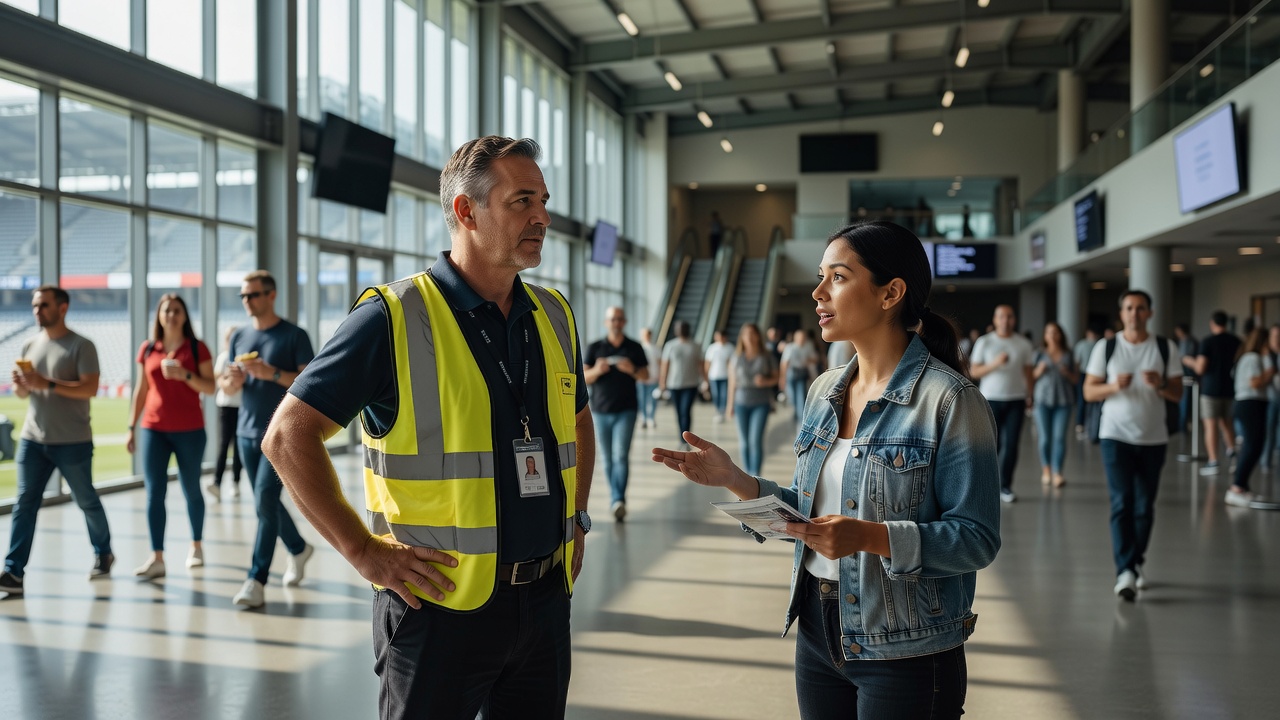
Keep decision authority clear
When AI enters venue operations, the central question is not simply whether a model performs well in a test. It is what the system is allowed to influence, who can act on its output and how the organisation recognizes an error. A recommendation can be timely and still be inappropriate for a particular place or visitor. Staff must know that they can pause, challenge or disregard it when live conditions call for a different response.
Define the system's role before it is introduced. A tool might summarize aggregate counts or flag a change for review. It should not be described as making a safety determination unless the relevant authority, evidence and procedures genuinely support that claim. Make the distinction clear in training, interface language and supplier documentation. Avoid labels that imply certainty where the output is a forecast or estimate.
Meaningful human review needs practical support
Human oversight is not a name attached to an automated workflow. The person reviewing an output needs enough time, context, competence and authority to make an independent judgement. If staff receive a stream of poorly prioritized alerts, lack access to the underlying evidence or are penalized for challenging automation, review may become a formality. Design the process around how real shifts work, including handovers, fatigue, workload and the need to communicate decisions quickly.
For important outputs, identify a primary owner and a backup. State what the alert means, where it applies, when it was produced and whether inputs are missing. Provide a way to mark it as checked, disputed or not actionable. If a decision affects route availability or service, record the reasoning and communication through established event procedures. Give frontline staff a route to raise concerns without needing to diagnose the model themselves.
Test across ordinary and unusual conditions
Accuracy in a vendor demonstration is not proof of fitness in a real venue. Layout changes, low light, reflective surfaces, clothing, occlusion, weather, equipment movement and event-specific behaviour may affect performance. Test with the spaces, operating hours and visitor conditions where the tool will actually be used. Evaluate not just average performance but failure modes: delayed readings, missing zones, false alarms and sudden changes when a camera or sensor is obstructed.
Ask who was represented in testing and whether performance differs across relevant environments. Do not use visitor characteristics as a proxy for risk. Where a system is unsuitable for a context, disable it or require a different method. Document assumptions, thresholds and known limitations in language that staff can understand. Review the results after operational changes, not only at initial procurement.
Use privacy as a design constraint
Start with the purpose and collect only information needed for it. Many questions about movement or room use can be answered through aggregate counts rather than identifying individuals. Prefer local processing or short-lived transformation where it is appropriate, restrict access to raw data and set retention periods that reflect a genuine need. Do not quietly repurpose an operations system for unrelated monitoring or evaluation.
People should be able to understand what data are used, why, who can see them and how long they remain. Clear signage and accessible explanations help, but notice alone does not make excessive collection acceptable. Review supplier access, security arrangements, onward use, deletion, incident response and audit options. Keep records of the purpose, alternatives considered, responsible owner and review date.
Make accountability part of procurement
Before buying or renewing a system, ask for a description of its inputs, output types, known limitations, update process and fallback behaviour. Clarify whether the supplier can use data to train or improve other products. Understand how updates are announced and tested, who handles support during an event, and what happens if a contract ends. Require a clear route for complaints and technical incidents.
Procurement should involve the people who will use the system, privacy and security specialists, facilities teams, event operations and relevant representatives of visitors or workers. A pilot needs a defined scope and stopping conditions. Its review should consider usefulness, staff workload, accessibility, privacy, errors and unintended consequences. A tool that fails to add meaningful operational value should not be kept merely because it is already installed.
Respect the boundary between insight and safety
Automated analysis can surface a pattern, but it cannot establish every relevant fact. A model may not know why a route is blocked, whether an individual needs assistance, or what a steward has just observed. Safety authority relies on trained people, venue procedures, live context and the accountable roles established for the event. Digital indicators are one input among others, not an independent substitute for these responsibilities.
In a disagreement, the process should invite verification rather than force a contest between a person and a machine. Staff should be able to use radio communication, direct inspection and existing command channels. The venue should record significant overrides and review them for lessons, without assuming that every override is an error. Likewise, an automated suggestion that happens to be accepted is not automatically a good decision; the reasoning and results still deserve attention.
Review, explain and improve
Governance continues after launch. Set a regular review schedule and triggers such as a system update, a new use, a serious incident, a complaint or a change to the venue. Include staff feedback, system performance, data access and retention, security events, visitor experience and whether the original purpose still exists. Share relevant findings internally and make public information understandable where appropriate.
Accountability is ultimately a relationship between an organisation and the people affected by its choices. It asks whether there is someone who can explain a decision, correct a mistake and make a better choice next time. When AI is treated as decision support, with visible limits and genuine human responsibility, it can contribute to more thoughtful operations without becoming the authority over the people a venue serves.